Showing posts with label makerbot. Show all posts

Thursday, December 11, 2014

SPACE SAMPLING SPACE COAST

If you have been following the past blogs on our Space Coast Tour you may have noticed some reoccurring themes such as the relationship of nature to mechanization, and a fascination into ways of exploring things from different perspectives.


One personal favorite viewing mechanism has always been the Hubble Telescope pictured above with the NASA Airstream : aka the Astrovan that transfers astronauts from the operations and checkout building to the launch pad.


Up at the crack of dawn we made our way to witness the first rocket launch of Orion. Orion will be the first spacecraft since Apollo that will facilitate human exploration of destinations beyond  Low Earth Orbit such as the Moon, asteroids, and Mars.


Arriving at 4am to the Kennedy Space Center we waited .. and waited ... even the alligators were waiting ... after several hours we were notified that the launch will be postponed until the next morning Friday 5th Dec. It was worth the wait!


The Orion Spacecraft is a multi purpose Crew Vehicle intended to carry a crew of up to four astronauts to destinations beyond-low Earth orbit. It was a successful mission going twice around the earth before shooting off another 3,600 miles taking it past the International Space Station close to Mars and back down to earth in four and a half hours.


Even from such a distance one could feel the force especially the after noise, it was phenomenal.


The most powerful liquid-fueled rocket engine ever produced, the F-1 engine, was a critical component in sending astronauts to the moon during the Apollo Program. Developed under the direction of Wernher von Braun, the Saturn V rocket was also the largest. Standing 36 stories high and weighing over 6 million pounds it required a cluster of five F-1 engines generating more than 7.5 million pounds of thrust to lift the rocket off the pad.


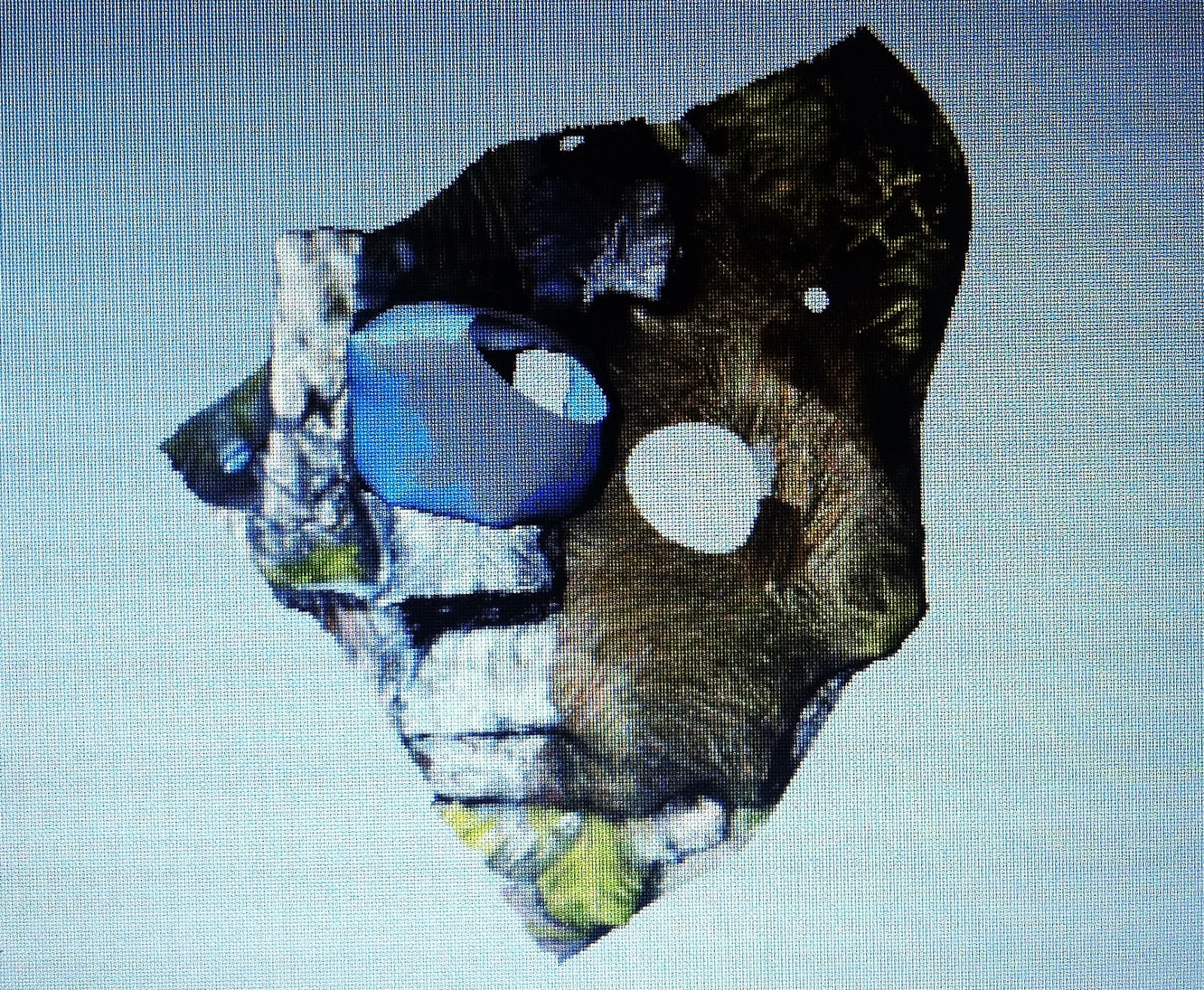
We chose to scan the F-1 engine onsite and explored stereo collaging it with other 3D models using a method developed by Paul back in 1994 which he termed 'Space Sampling'.


'FALLEN BLOCK ISLAND F-1 APOLLO'
* available as print

The space program has used a lot of classical references for its legend, the above work is a combination of those legends and consists of the photogrammetric scan of the F-1 Engine that we made onsite at the Kennedy Space Center, a 3d laser scan taken directly from the Parthenon of the Greek deity 'Apollo' combined in belvedere with the Block Island Meteorite found on Mars by the Opportunity Rover and Aurora 7 the first US Spacecraft.


The Shuttle Atlantis named after the utopian novel by Sir Francis Bacon published in 1627 has a textilian surface like a woven blanket which echos the layered fabric called 'Flong' which received the output from Charles Babbage's Difference Engine: the first computer stereotyping bed.


'F-1 ATLANTIS APOLLO'
* available as print

'We have also perspective houses ...........we make artificial rainbows, halo's and circles about light. We represent all manner of reflexions, refractions and multiplications of visual beams of objects' 
  
Except from The New Atlantis'  by Sir Francis Bacon 1627


 After 8 weeks on the road our last days on the Space Coast has bought our tour to a close. We have traveled in our silver machine, the airstream fab lab a total of 3400 miles through 8 States, Lecturing as visiting artists at 6 universities and exploring many sites of interest as well as participating in major events such as Art Miami, Jacksonville Iron Pour and The Orion Rocket Launch.

Next stop is back to the Studio where we will develop some of the ideas for exhibition : please watch this space for the completed series of Space Coast bronzes and prints.

Thanks to everyone who made this tour a real pleasure!


Over and Out : Moon walking on the Space Coast 2014

Monday, December 8, 2014

CORAL CASTLE : An Outdoor Observatory

The first time I visited Coral Castle was New Years Day 2014 and I knew I had to come back and take a closer look at this 'Unusual Accomplishment'. It is one of the most authentic tourist attractions along Route 1 just one hour south of Miami. 


Coral Castle was designed and built by Latvian immigrant Ed Leedskalnin between 1920 to 1951.  He cut and raised the walls from the Coral bedrock on site where it stands today. Most of the carved rocks/furniture inside the Castle were made at its original location in Florida City and moved here by Ed and a friend with a tractor in 1936.


What I find particularly interesting about his home is that it also functions as an outdoor observatory used for viewing, recording and documenting terrestrial and celestial events, many of the rock chairs face specific directions and many are designed so you can look up at the sky easily.


In front of 'The Planets' sits an assortment of chairs, each weighing approximately 1,000#. The absence of chisel marks gives the appearance of natural growth.


I focused my research on the ‘Polaris Telescope’ and ‘The Sundial’ as well as documenting via scanning the 'Three Ton Gate' which pivots effortlessly being perfectly balanced on the axle of a model T Ford since 1936.


Ed Leedskalnin wrote three books on magnetic current and it is believed by some that he used this technology in order to move the stones.


Gravity has always been an obvious challenge as a sculptor so the idea of moving multi ton blocks with magnetic current is very intriguing. I took scans of the 'Three Ton Gate' Coral Rock and am working on the concept of a levitating sculpture.This is a theme I have addressed before in 'Lodestone' using cast copper and aluminum.


There are two components to the ‘Polaris Telescope’ the outer part is a 25ft tall tower, with the aligning eye piece located 20 ft away inside the castle grounds.


 At night when the sets of crossed wires in the inner and outer pieces are aligned one can see and track the North Star. 


By making these scans and 3d models within the computer it allows me to examine the texture of the Coral rocks as well as to experience them differently opening up exciting new possibilities. This is the aerial view of the 25ft Polaris Tower.


I am not interested in simply replicating the objects that Ed Leedskalnin has made but to know and understand them better for translation.


Below are the raw texture maps created by the 3D model.


By using his Polaris Telescope Ed could study and record the path the earth travels which enabled him to obtain the data to build his sundial.


The numbered loops on the sundial represent hours, the unnumbered loops are half hours. The shadow cast by the metal indicator on the coral block above points to the time.

I would like to give a special thanks to The Sun for shining during both visits!


Next Stop SPACE COAST : ORION ROCKET LAUNCH

Wednesday, December 3, 2014

'The Thiefs Inlet'

Amok with chic boutiques and high rise condos the word 'Boca' refers to an inlet once known as 'The Thiefs Inlet'.


Greeted by the Muscovy ducks upon arrival we set up at the Sculpture Studios and immediately attracted the attention of students and faculty whom came to see what we were working on.


Our visit to FAU was beautifully orchestrated by Sculpture Professor Julie Ward pictured in the airstream doorway above. We can seat about ten people inside the airstream with a few standing so tours resulted in a constant stream of visitors including art and engineering students and faculty from across campus.


 During the tours we continued to work on projects with the scanner and the 3D printer.


Using the laser scanner we began to scan some coral samples collected along the way.  The scanner consists of a turntable which rotates through 360 degrees and back again as two stereo lasers capture the surface structure and shape of the object.


These are experiments to see what happens to the surface detail of the coral when scanned and to explore the textures created.


  Scans of multiple passes and different orientations will later be prototyped in plastic on the 3D printer and used as reference models for enlarging.


 After our public lecture we carried out critiques of several of the graduating senior exhibitions and continued discussions in the airstream.

 
A special Thank You to Julie Ward and all at Florida Atlantic University who made us so welcome.


Next Stop Miami Art Basel 25th Anniversary VIP Reception.

Tuesday, December 2, 2014

A1A The Scenic Route

Leaving Jacksonville we continued to head south. Closely following the Atlantic coastline we took the slow road and winded our way between Historic Route 1 and Scenic Route A1A which are the most eastern and among the oldest routes in the United States.


We set up camp at Tomoka State Park just north of Ormond and Daytona Beach. 


The beach between Ormond and Daytona is the original site of the world land speed breaking records starting in the 20’s onwards and you can still drive on the beach today. Plenty of hotrods and custom gaslamp cars to see.


This 1968 Roadrunner R/T Car reminded Paul of a series of collages he made in 1976 based on catastrophe histograms that went with a series of his game theoretic sculptures.


Tomoka State Park is home of the spirit of great chief Tomoka, we were informed that if we saw anything strange in the woods to not be surprised, unfortunately we did not see any but his statue.


We investigated another Indian burial mound in Ormond this one was much better preserved than the Santee Mound/Fort Watson in South Carolina which made it difficult to take in the round photographs : pictured below


These are two of many mounds to visit in the south east. The Ormond mound contains as many as 125 bodies and is sited in someones back yard.


Using photogrammetry we scanned the earthwork as a way of documenting our experience of it, these photographs will enable us to later create a 3D model of it to possibly use in my future work.

Ormond Beach was also the winter home of J D Rockefeller where he hosted his friends notably the comedian and 'Populist Cowboy' Will Rogers 1879-35. Paul believes that the 1957 movie ‘A Face in the Crowd’ is based upon this location and the real life friendship between Will Rogers and Rockefeller as Rockefeller saw the advantage in exploiting the common man by passing political memes through popular entertainers and figures. 'political satire can be as dangerous as an unguided missile when it is unsound' James Thurber 1968.


Winding down Route 1 we came across many sites of 50’s and 60’s Americana as this was the old route taken by vacationers from New York, tiny motels too many to mention including a steamboat car wash, and we just had to stop at the moonlight drive in diner for a bite.
 
Before arriving at our next visiting artist engagement we treated ourselves and the Airstream to an overnight stop at the famous Land Yacht Harbor, an Airstream only park where the fab lab was able to reunite with many old friends.


Next Stop is Florida Atlantic University in Boca Rotan, Florida : Public Lecture at Noon on Monday 24th November.